NITI Aayog Report on Key Sectors to Position India as a Global Manufacturing Hub
14 Aug 2026
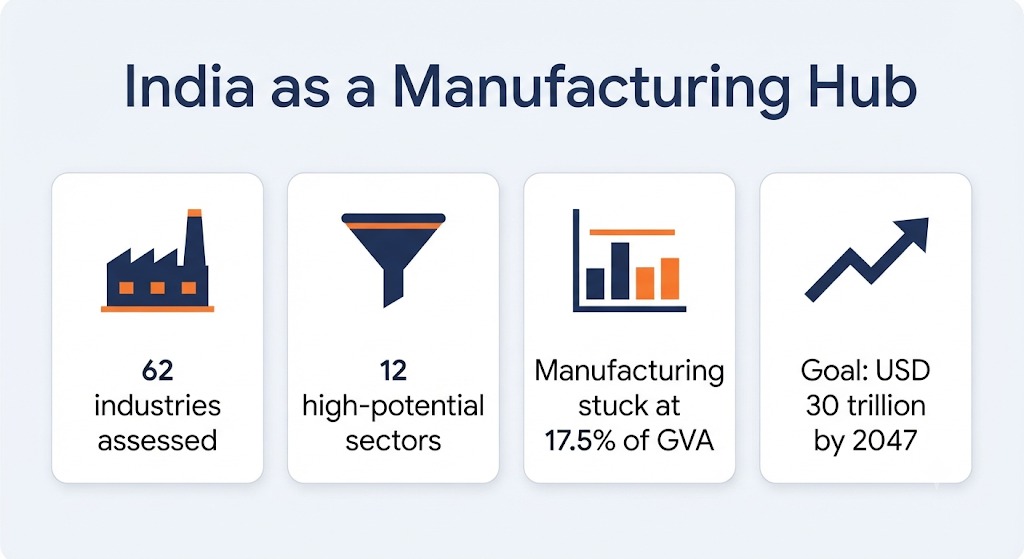
Consider the following statements regarding the NITI Aayog report titled “Key Sectors to Position India as a Global Manufacturing Hub (Volume-I)”: The report aims to elevate the manufacturing sector's share of GVA to support the objective of a USD 30 trillion economy by 2047. It evaluates industries starting from an initial pool of 62 sectors assessed through a market size and growth matrix. Which of the statements given above is/are correct?
- 1 only
- 2 only
- Both 1 and 2
- Neither 1 nor 2
Practice questions are answered inside your account. Create a free account, or see what practice includes.
With reference to the chemical sector targets outlined in the recent NITI Aayog manufacturing report, consider the following: The local chemical market is targeted to reach USD 290–310 billion by FY30. The strategy focuses entirely on basic bulk chemicals while avoiding specialty chemicals like agrochemicals and dyes. Which of the statements given above is/are correct?
- 1 only
- 2 only
- Both 1 and 2
- Neither 1 nor 2
Practice questions are answered inside your account. Create a free account, or see what practice includes.
Which of the following describes the textile sector export and strategic goals presented in the NITI Aayog manufacturing blueprint?
- Achieving USD 50 billion in exports by FY30 with a primary focus on traditional raw cotton
- Expanding the textile trade size to USD 350 billion with USD 100 billion in exports by FY30, pivoting toward man-made fibres and technical textiles
- Restricting the sector exclusively to natural silk and wool production to bypass global competition
- Maintaining the current share of handloom exports while phasing out industrial textile manufacturing
Practice questions are answered inside your account. Create a free account, or see what practice includes.
Consider the following challenges identified in Indian manufacturing within the NITI Aayog report: High import dependence for industrial inputs like methanol and acetic acid. Inverted duty frameworks where finished downstream merchandise can face lower tax rates than raw inputs. High fragmentation among MSME textile units with aging technology. Which of the statements given above are correct?
- 1 and 2 only
- 2 and 3 only
- 1 and 3 only
- 1, 2 and 3
Practice questions are answered inside your account. Create a free account, or see what practice includes.
What is the primary objective of the Solar Photovoltaic (PV) manufacturing strategy proposed in Volume-I of the NITI Aayog report?
- To completely ban the import of solar modules without developing domestic upstream capacities
- To build fully connected, end-to-end solar supply chains spanning from polysilicon, ingots, and wafers to cells and modules
- To rely exclusively on imported polysilicon while limiting domestic activity to final assembly
- To reduce India's total installed solar capacity target below current operational levels
Practice questions are answered inside your account. Create a free account, or see what practice includes.