Deepening Inequality: The Crisis in India’s Education and Employment
26 Mar 2026
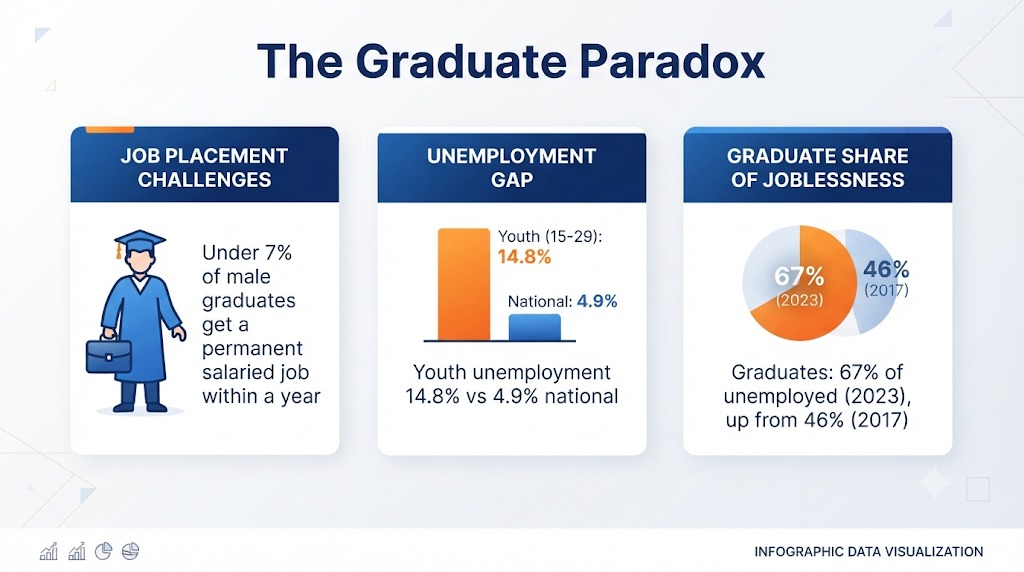
Consider the following statements regarding the findings of the State of Working India (SWI) report: The joblessness rate among the 15–29 age cohort is approximately triple the national average. In 2023, two-thirds of jobless Indians aged 20–29 were university graduates. Within a year of completing schooling, more than 20% of male degree-holders secure permanent salaried positions. Which of the statements given above are correct?
- 1 and 2 only
- 2 and 3 only
- 1 and 3 only
- 1, 2 and 3
Practice questions are answered inside your account. Create a free account, or see what practice includes.
With reference to the structural challenges in India's education and employment sectors, consider the following statements: Student-teacher ratios in state colleges often exceed the recommended standards due to lagging faculty expansion. The proportion of young males engaged in studies increased steadily between 2017 and late 2024. A significant majority of young males who stopped studying did so to assist family finances. Which of the statements given above are correct?
- 1 and 2 only
- 1 and 3 only
- 2 and 3 only
- 1, 2 and 3
Practice questions are answered inside your account. Create a free account, or see what practice includes.
Which of the following best describes the phenomenon referred to as 'Degree Inflation' in the context of recent labor market trends in India?
- The rapid rise in tuition fees across higher educational institutions.
- The increasing proportion of university graduates among the unemployed population.
- The devaluation of technical diplomas compared to vocational certifications.
- The inflation-adjusted growth of starting salaries for professional degree-holders.
Practice questions are answered inside your account. Create a free account, or see what practice includes.
Consider the following factors contributing to the employment crisis in India: The Indian economy transitioned directly into a service-dominated sector requiring high skill levels, bypassing a robust manufacturing phase. High student-teacher ratios in state colleges severely constrain technical training quality. A high conversion rate of internships into permanent employment by formal organizations. Which of the factors given above contribute to the challenges in the labor market?
- 1 and 2 only
- 2 and 3 only
- 1 and 3 only
- 1, 2 and 3
Practice questions are answered inside your account. Create a free account, or see what practice includes.
What is the primary objective of introducing an employer-driven apprenticeship scheme in organized manufacturing, as proposed in recent policy recommendations?
- To replace existing minimum wage regulations with performance-linked incentives
- To trade unemployment doles for practical, structured workforce entry pathways
- To increase the enrollment share of female students in higher education
- To centralize technical skill certification under a single apex bureaucratic body
Practice questions are answered inside your account. Create a free account, or see what practice includes.