India’s Gen Z and Unemployment
20 Jul 2026
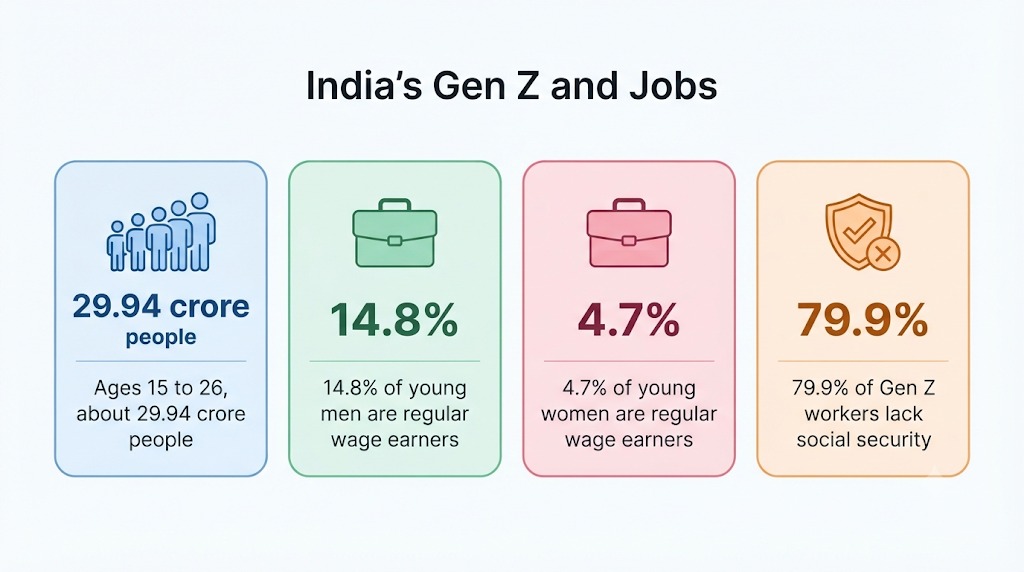
Consider the following statements regarding the demographic profile and Labour Force Participation Rate (LFPR) of India's Generation Z according to recent Periodic Labour Force Survey (PLFS) evaluations: Generation Z comprises working-age individuals born from 1997 through 2012. The overall LFPR for Generation Z is significantly higher than that of Millennials. Regular wage employment accounts for less than 15% of young Gen Z males. Which of the statements given above are correct?
- 1 and 2 only
- 1 and 3 only
- 2 and 3 only
- 1, 2 and 3
Practice questions are answered inside your account. Create a free account, or see what practice includes.
With reference to the state of informal work and social security among India's Gen Z workforce, which of the following best describes their working conditions?
- Roughly 80% of Gen Z workers have zero social security coverage, and only a small fraction hold a formal employment contract.
- More than half of Gen Z females are engaged in regular salaried urban employment with full social security benefits.
- The majority of young workers are protected by long-term formal contracts due to stringent industrial regulations.
- Casual laborers and unpaid family workers constitute less than ten percent of the total Gen Z working population.
Practice questions are answered inside your account. Create a free account, or see what practice includes.
Which of the following policy measures is explicitly recommended to address the structural barriers preventing young women in India from entering and remaining in the paid workforce?
- Banning automation in all service sector industries to preserve administrative positions
- Scaling up safe urban public transit, subsidized childcare facilities, and adaptable work policies
- Replacing all formal manufacturing jobs with temporary gig economy positions
- Eliminating higher education institutions to force immediate entry into casual labor
Practice questions are answered inside your account. Create a free account, or see what practice includes.
What is the primary economic implication of failing to integrate India's Gen Z demographic into productive and formal employment?
- An immediate and permanent surplus in household financial investments across all income groups
- The elimination of structural inflation and a sharp rise in long-term domestic consumer demand
- Converting a potential demographic dividend into a persistent fiscal liability and falling into low-productivity traps
- A complete transition of the national economy away from industrial manufacturing toward agrarian self-sufficiency
Practice questions are answered inside your account. Create a free account, or see what practice includes.