Land Revenue Settlements: Permanent, Ryotwari and Mahalwari
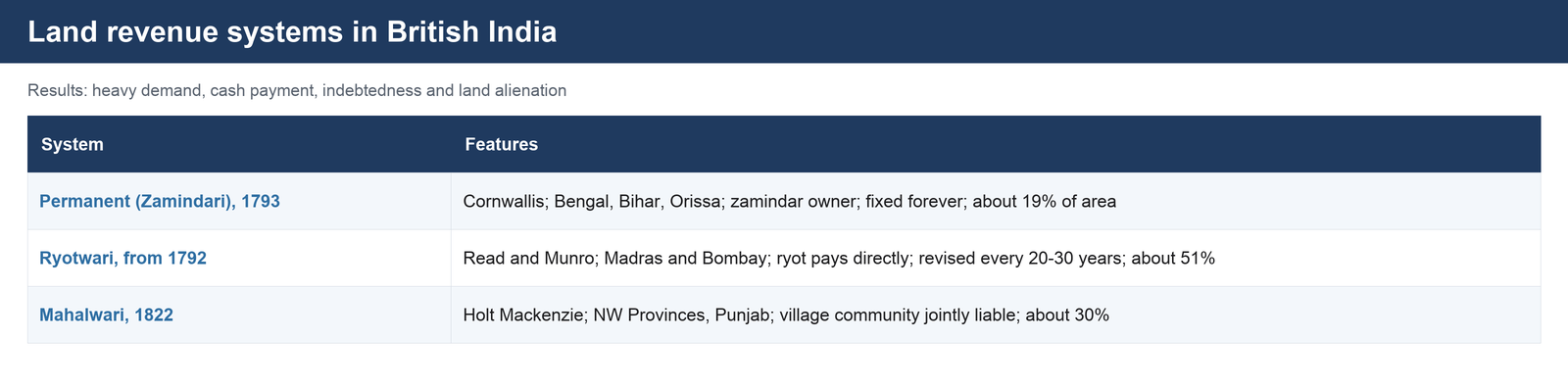
| Feature | Permanent (Zamindari) | Ryotwari | Mahalwari |
|---|---|---|---|
| Introduced | 1793, Cornwallis | 1792 onward, Read and Munro | 1822, Holt Mackenzie; 1833 Bird |
| Region | Bengal, Bihar, Orissa; part of Madras and Benares | Madras, Bombay, Assam, parts of Berar | North-West Provinces, Punjab, Central Provinces, Awadh |
| Revenue paid by | Zamindar | Ryot directly | Village community through its headman |
| Revenue fixed | Permanently | Revised every 20-30 years | Revised periodically |
| Share of British India | About 19% | About 51% | About 30% |
The Permanent Settlement was introduced in
- 1793
- 1765
- 1822
- 1857
Practice questions are answered inside your account. Create a free account, or see what practice includes.
Which system was introduced in the Madras Presidency?
- Ryotwari
- Mahalwari
- Zamindari only
- Taluqdari
Practice questions are answered inside your account. Create a free account, or see what practice includes.
In the Mahalwari system, revenue was collected from
- The village community through its headman
- Each ryot separately
- The zamindar
- The Company's agent
Practice questions are answered inside your account. Create a free account, or see what practice includes.
The Deccan Riots of 1875 were related to
- Moneylenders and the ryotwari burden
- Indigo planters
- Railway construction
- Press laws
Practice questions are answered inside your account. Create a free account, or see what practice includes.
Under the Permanent Settlement the zamindar was
- Hereditary owner of the land
- A salaried tax collector
- A tenant of the state
- A village headman
Practice questions are answered inside your account. Create a free account, or see what practice includes.