Legislative Relations between the Centre and the States
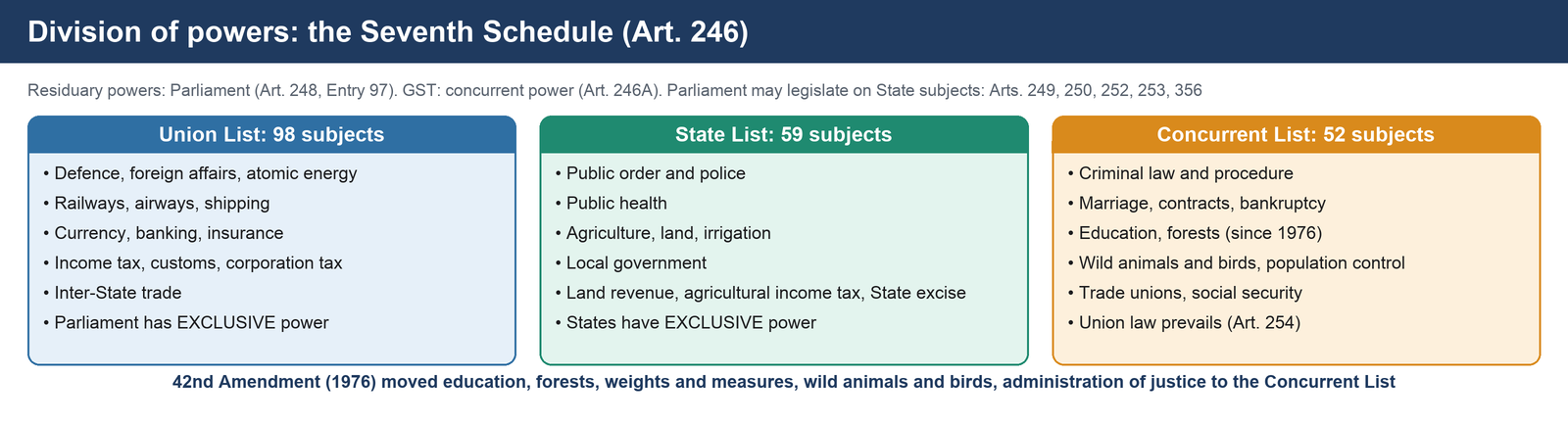
| Situation | Article | Effect |
|---|---|---|
| Rajya Sabha resolution in national interest | 249 | Parliament may legislate on State List for up to one year (renewable) |
| National Emergency | 250 | Parliament legislates on State List; lapses 6 months after Emergency |
| Request by two or more States | 252 | Parliament legislates; adoption by other States possible |
| International treaties | 253 | Parliament can legislate on any subject to implement them |
| President's Rule | 356 | Parliament (or President) legislates for the State |
- Article 246A
- Article 248
- Article 249
- Article 252
- Article 253
- Article 254
Match with: Rajya Sabha resolution in national interest · Request by two or more States · Repugnancy · Residuary powers · International agreements · Goods and Services Tax
Practice questions are answered inside your account. Create a free account, or see what practice includes.
Under Article 249, Parliament can legislate on a State List subject if the
- Lok Sabha passes a resolution by two-thirds majority
- Rajya Sabha passes a resolution by two-thirds of members present and voting
- President declares
- Supreme Court allows
Practice questions are answered inside your account. Create a free account, or see what practice includes.
Residuary powers of legislation are vested in
- States
- Parliament
- Supreme Court
- President
Practice questions are answered inside your account. Create a free account, or see what practice includes.
Which of the following subjects was transferred to the Concurrent List by the 42nd Amendment?
- Public health
- Education
- Police
- Agriculture
Practice questions are answered inside your account. Create a free account, or see what practice includes.
A law enacted on the request of two or more States under Art. 252 can be amended by
- Any of those State legislatures
- Parliament only
- President
- Governor
Practice questions are answered inside your account. Create a free account, or see what practice includes.
In a conflict between Union and State laws on a Concurrent List subject
- The State law always prevails
- The Union law prevails, unless the State law was reserved for the President and received assent
- The Supreme Court decides each time
- Both are void
Practice questions are answered inside your account. Create a free account, or see what practice includes.
Under Article 253, Parliament can legislate on any subject to
- Tax agricultural income
- Implement international treaties and agreements
- Regulate local bodies
- Reorganise States
Practice questions are answered inside your account. Create a free account, or see what practice includes.