Module 1 · Lesson 2 of 23 min read
Human Values and Moral Thinkers: India and the West
Figure: ethical theories compared
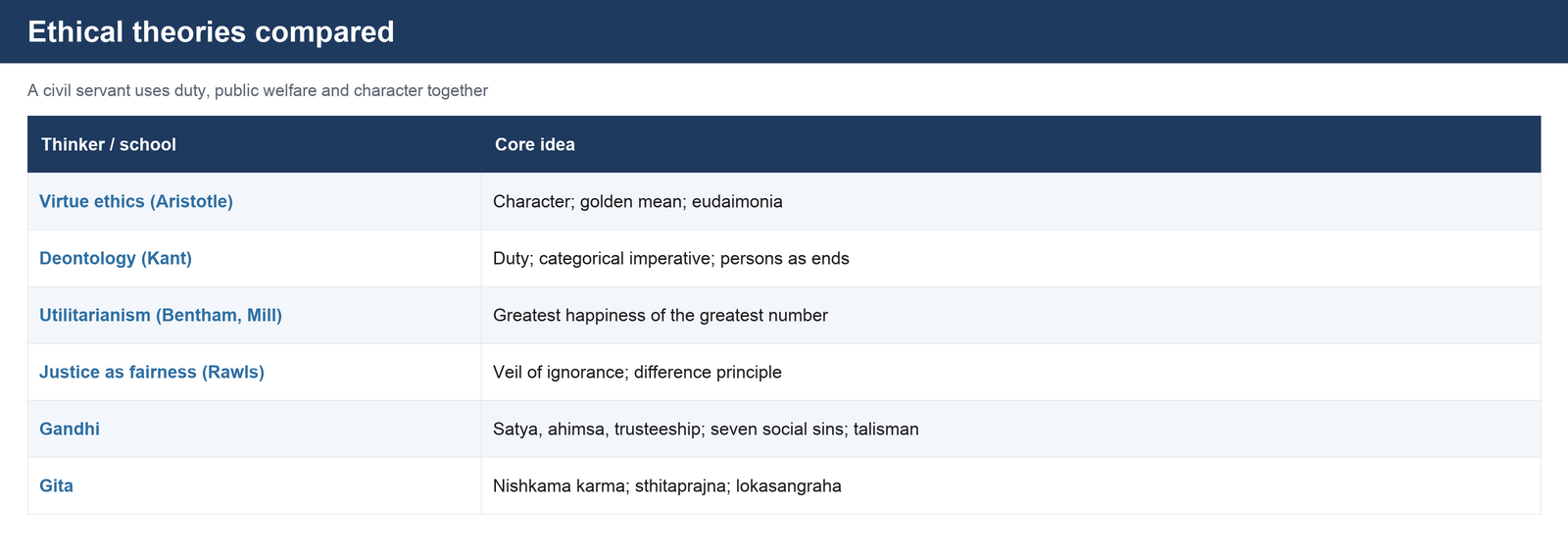
| Theory / thinker | Core idea | Use and limits |
|---|---|---|
| Virtue ethics (Aristotle) | Right action flows from virtuous character; the 'golden mean'; eudaimonia (flourishing) | Focus on character; less guidance in dilemmas |
| Deontology (Kant) | Duty and the categorical imperative: act on principles you could will as a universal law; treat humanity as an end, never only as a means | Firm rules, respect for persons; rigid |
| Utilitarianism (Bentham, J. S. Mill) | The greatest happiness of the greatest number; Mill distinguishes higher and lower pleasures | Policy-friendly; may sacrifice minorities |
| Social contract (Hobbes, Locke, Rousseau) | Authority rests on consent for mutual benefit | Basis of the state and rights |
| Justice as fairness (Rawls) | Choose principles behind a 'veil of ignorance'; the difference principle | Fairness, equality of opportunity |
| Ethics of care (Gilligan, Noddings) | Relationships and responsibility | Empathy; may be partial |
| Existentialism, relativism | Individual choice; culture-bound morals | Autonomy; risk of no common standard |
Practice question
The 'categorical imperative' is from
- Kant
- Mill
- Bentham
- Aristotle
Practice questions are answered inside your account. Create a free account, or see what practice includes.
Practice question
The 'veil of ignorance' is associated with
- Rawls
- Hobbes
- Gandhi
- Marx
Practice questions are answered inside your account. Create a free account, or see what practice includes.
Practice question
Nishkama karma is from the
- Bhagavad Gita
- Arthashastra
- Tirukkural
- Manusmriti
Practice questions are answered inside your account. Create a free account, or see what practice includes.
Practice question
Which of these is a Gandhian 'social sin'?
- Politics without principle
- Rest on Sunday
- Reading books
- Travel
Practice questions are answered inside your account. Create a free account, or see what practice includes.
Practice question
Utilitarianism judges acts by their
- Consequences
- Intentions only
- Rules only
- Tradition
Practice questions are answered inside your account. Create a free account, or see what practice includes.