Module 9 · Lesson 1 of 33 min read
Art and Architecture of Ancient India
Figure: schools of Buddhist sculpture
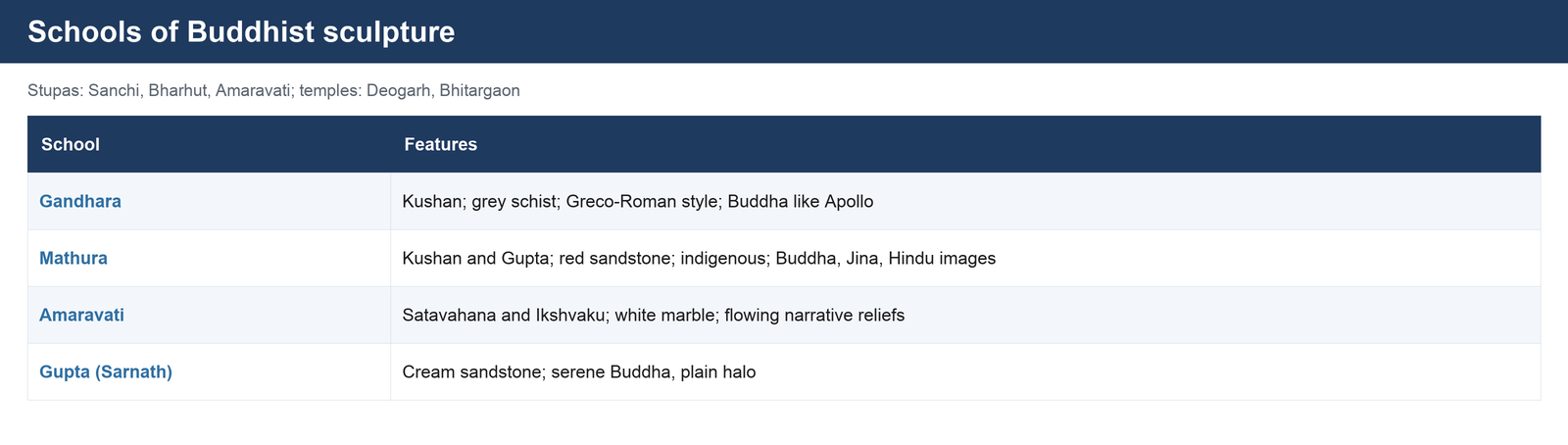
| School | Period | Patron | Material and features |
|---|---|---|---|
| Gandhara | 1st c. BCE - 5th c. CE | Kushans (Kanishka) | Grey schist; Greco-Roman style; Buddha in a wavy-haired Apollo-like form; Greco-Buddhist |
| Mathura | 1st - 6th c. CE | Kushans, Guptas | Spotted red sandstone; indigenous style; Buddha, Jina and Hindu images; Kanishka's headless statue |
| Amaravati | 2nd c. BCE - 3rd c. CE | Satavahanas, Ikshvakus | White marble; flowing narrative reliefs; Buddha initially as symbols |
| Gupta (Sarnath) | 4th - 6th c. CE | Guptas | Cream sandstone; serene Buddha with a plain halo and downcast eyes |
Practice question
The Dashavatara temple is at
- Deogarh
- Bhitargaon
- Tigawa
- Nachna
Practice questions are answered inside your account. Create a free account, or see what practice includes.
Practice question
The Gandhara school was influenced by
- Greek and Roman art
- Chinese art
- Persian Safavid art
- Dravidian art
Practice questions are answered inside your account. Create a free account, or see what practice includes.
Practice question
Which of the following is made of white marble and associated with the Satavahanas?
- Amaravati
- Sanchi toranas
- Mathura
- Karle
Practice questions are answered inside your account. Create a free account, or see what practice includes.
Practice question
The Mehrauli Iron Pillar is famous for
- Its resistance to rust
- Its gold coating
- Ashoka's edicts
- Its height of 30 m
Practice questions are answered inside your account. Create a free account, or see what practice includes.