Text, Ingredients and the Nature of the Indian State
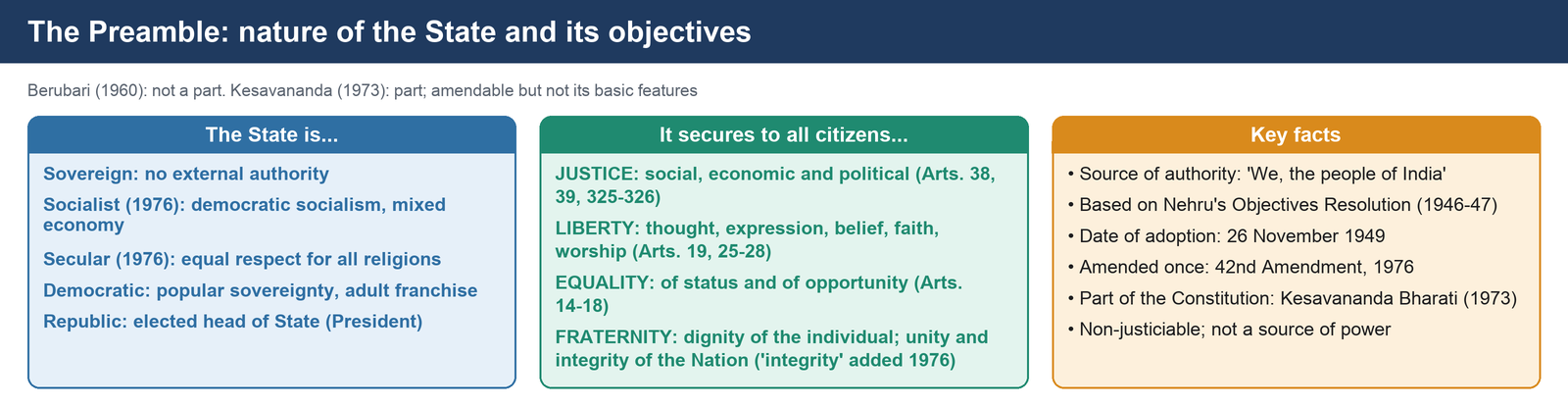
| Key word | Meaning in the Indian context | Where else it appears |
|---|---|---|
| Sovereign | Independent; no external authority; free to conduct internal and external affairs | Art. 1 (Union), Art. 51 (foreign policy) |
| Socialist | Democratic socialism; mixed economy; reducing inequality | Directive Principles, Arts. 38-39, 41-43 |
| Secular | Equal treatment of all religions; no State religion | Arts. 14-16, 25-28 |
| Democratic | Popular sovereignty; representative parliamentary democracy | Art. 326 (adult franchise), Part XV |
| Republic | Elected head of State (President); no hereditary privilege | Art. 54 (election of President), Art. 18 (no titles) |
Which of the following words was NOT added to the Preamble by the 42nd Amendment?
- Socialist
- Secular
- Integrity
- Sovereign
Practice questions are answered inside your account. Create a free account, or see what practice includes.
The Preamble is based on the
- Cabinet Mission Plan
- Objectives Resolution
- Government of India Act, 1935
- Mountbatten Plan
Practice questions are answered inside your account. Create a free account, or see what practice includes.
India is described as a 'republic' because
- It has a written constitution
- Its head of State is elected
- It is a federation
- It follows parliamentary democracy
Practice questions are answered inside your account. Create a free account, or see what practice includes.
Indian secularism is best described as
- Strict separation of religion and State
- State religion with tolerance
- Equal respect and treatment of all religions by the State
- Atheism promoted by the State
Practice questions are answered inside your account. Create a free account, or see what practice includes.
Which of the following was held to be a basic feature of the Constitution in S.R. Bommai (1994)?
- Socialism
- Secularism
- Republic
- Plebiscite
Practice questions are answered inside your account. Create a free account, or see what practice includes.
The Constituent Assembly enacted the Preamble
- Before the rest of the Constitution
- After the rest of the Constitution
- Along with the Fundamental Rights
- On 26 January 1950
Practice questions are answered inside your account. Create a free account, or see what practice includes.