Amending the Constitution: Article 368 and the Three Methods
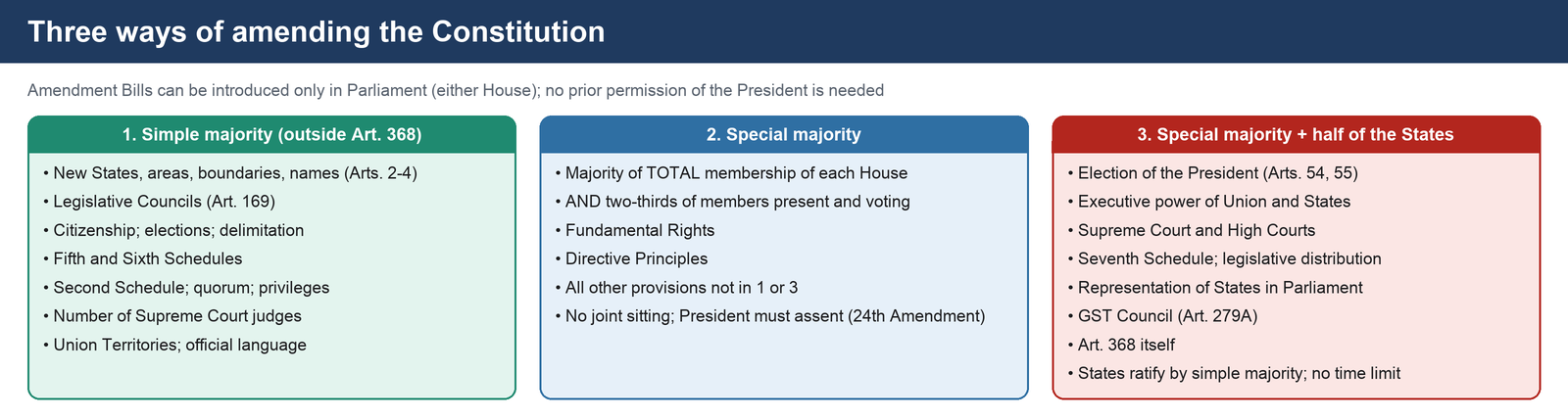
1. Initiation: only in Parliament
| Method | Majority needed | Examples |
|---|---|---|
| Simple majority (outside Art. 368) | Majority of members present and voting | New states and boundaries (Arts. 2-4), Legislative Councils (Art. 169), citizenship, elections, Fifth/Sixth Schedule |
| Special majority | Majority of total membership AND two-thirds of those present and voting, in each House | Fundamental Rights, Directive Principles, most other provisions |
| Special majority + states | Same as above PLUS ratification by half of the State Legislatures (simple majority) | Election of the President, Supreme Court/High Courts, Seventh Schedule, representation of states in Parliament, Art. 368, GST Council |
Which of the following can be amended by a simple majority of Parliament?
- Fundamental Rights
- Election of the President
- Formation of new states
- Seventh Schedule
Practice questions are answered inside your account. Create a free account, or see what practice includes.
An amendment affecting the Seventh Schedule requires
- Simple majority
- Special majority only
- Special majority and ratification by half of the states
- Unanimity of states
Practice questions are answered inside your account. Create a free account, or see what practice includes.
A Constitution Amendment Bill can be introduced
- Only in Lok Sabha
- In either House of Parliament
- In State Legislatures
- Only by the President
Practice questions are answered inside your account. Create a free account, or see what practice includes.
The President can
- Withhold assent to an amendment Bill
- Return an amendment Bill for reconsideration
- Neither withhold assent nor return the Bill
- Veto the Bill by pocket veto
Practice questions are answered inside your account. Create a free account, or see what practice includes.
'Total membership' of a House for the special majority means
- Members present and voting
- Total strength of the House irrespective of vacancies
- Members present
- Members of the ruling party
Practice questions are answered inside your account. Create a free account, or see what practice includes.
Which of the following is TRUE?
- A joint sitting resolves a deadlock on amendment Bills
- States can initiate amendments freely
- There is no time limit for state ratification
- Ratification needs two-thirds of state legislatures
Practice questions are answered inside your account. Create a free account, or see what practice includes.