Constitutional Remedies, Writs and the Limits of Fundamental Rights (Articles 31-35)
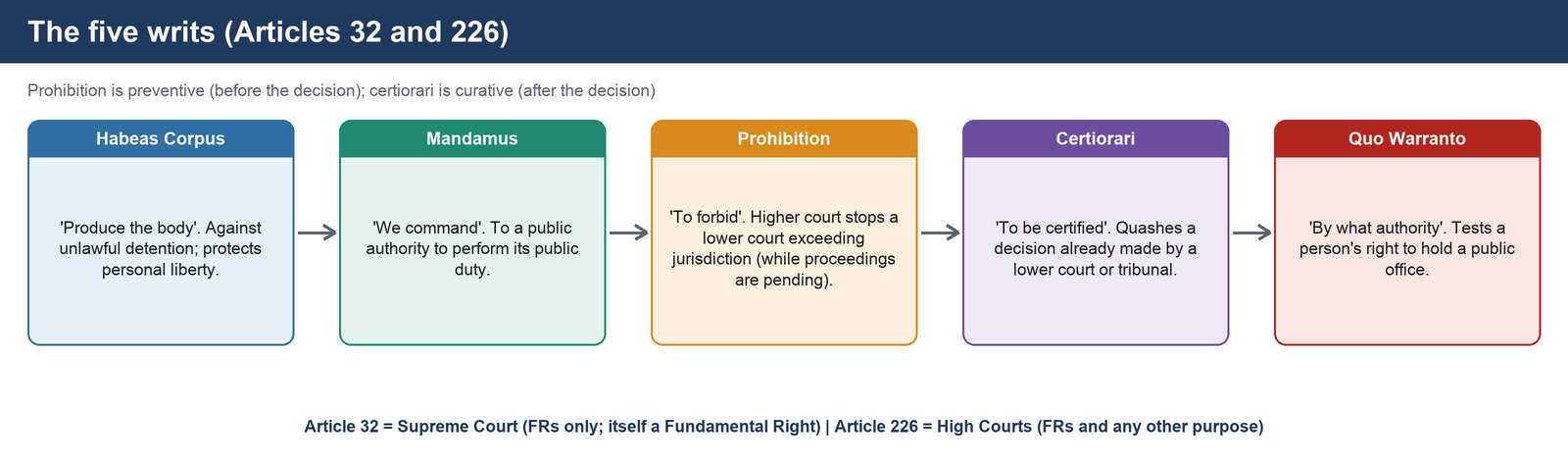
| Writ | Meaning | Issued against / when |
|---|---|---|
| Habeas Corpus | 'To have the body': produce the person in court | Against unlawful detention by public authority or private person; protects personal liberty |
| Mandamus | 'We command' | To a public official, body, corporation, tribunal or lower court to perform a public duty it has failed to do. Not against the President/Governors, private bodies (generally) or for discretionary duties |
| Prohibition | 'To forbid' | By a higher court to a lower court or tribunal to stop it exceeding jurisdiction or acting contrary to natural justice; issued while the proceeding is pending |
| Certiorari | 'To be certified' or quash | By a higher court to quash an order already passed by a lower court/tribunal for want of jurisdiction, error of law or violation of natural justice; issued after the decision |
| Quo Warranto | 'By what authority' | To stop a person from holding a public office he is not entitled to; for substantive public offices created by statute or Constitution; may be sought by any person, not just the aggrieved |
Step 1: Identify the violation
- Habeas corpus
- Mandamus
- Prohibition
- Certiorari
- Quo warranto
Match with: Quash an order of a lower court · By what authority do you hold this office · Produce the person in court · Stop a lower court from exceeding jurisdiction · Command a public authority to perform its duty
Practice questions are answered inside your account. Create a free account, or see what practice includes.
Which writ is issued by a higher court to a lower court to quash an order already passed?
- Mandamus
- Prohibition
- Certiorari
- Habeas corpus
Practice questions are answered inside your account. Create a free account, or see what practice includes.
The writ of quo warranto is issued to
- Release an illegally detained person
- Question the legality of a person holding a public office
- Compel a public duty
- Stop a lower court
Practice questions are answered inside your account. Create a free account, or see what practice includes.
Which of the following statements about Articles 32 and 226 is correct?
- Art. 226 is a Fundamental Right
- Art. 32 is available for enforcement of FRs only
- Art. 226 can be used only for FRs
- Art. 32 gives power to High Courts
Practice questions are answered inside your account. Create a free account, or see what practice includes.
Article 31B protects the laws placed in the
- Seventh Schedule
- Eighth Schedule
- Ninth Schedule
- Tenth Schedule
Practice questions are answered inside your account. Create a free account, or see what practice includes.
Which Article allows Parliament to restrict the Fundamental Rights of the armed forces?
- Article 32
- Article 33
- Article 34
- Article 35
Practice questions are answered inside your account. Create a free account, or see what practice includes.
Prohibition differs from certiorari in that prohibition is issued
- After the decision
- While the proceedings are pending
- Only against the President
- Only to private persons
Practice questions are answered inside your account. Create a free account, or see what practice includes.