Chief Minister, State Council of Ministers and the Advocate General
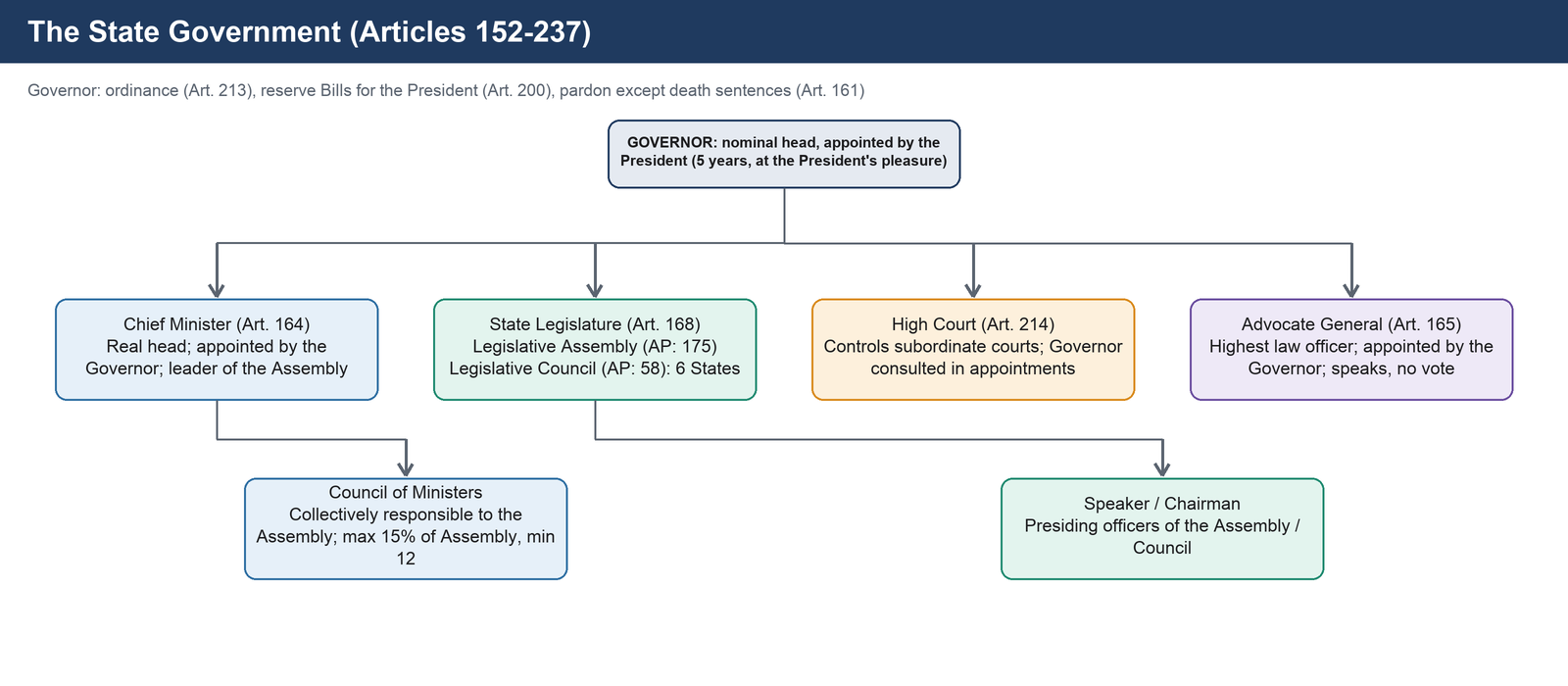
| Feature | Chief Minister | Prime Minister |
|---|---|---|
| Appointed by | Governor | President |
| Responsible to | Legislative Assembly | Lok Sabha |
| Size limit on Council | 15% of Assembly (min 12) | 15% of Lok Sabha |
| Channel of communication | Governor (Art. 167) | President (Art. 78) |
| Legal adviser | Advocate General (Art. 165) | Attorney General (Art. 76) |
| Resignation dissolves Council | Yes | Yes |
The Council of Ministers of a State is collectively responsible to
- The Governor
- The Chief Minister
- The Legislative Assembly
- The State High Court
Practice questions are answered inside your account. Create a free account, or see what practice includes.
The minimum number of ministers in a State (including the CM) is
- 8
- 10
- 12
- 15
Practice questions are answered inside your account. Create a free account, or see what practice includes.
The Advocate General of a State is appointed by the
- President
- Chief Minister
- Governor
- Chief Justice of the High Court
Practice questions are answered inside your account. Create a free account, or see what practice includes.
The CM is a link between the Governor and the Council of Ministers under
- Article 163
- Article 164
- Article 166
- Article 167
Practice questions are answered inside your account. Create a free account, or see what practice includes.
A person who is not a member of the State Legislature can be appointed Chief Minister but must become a member within
- One month
- Three months
- Six months
- One year
Practice questions are answered inside your account. Create a free account, or see what practice includes.
Which of the following is NOT true of the Advocate General?
- He can speak in the State legislature
- He can vote in the Assembly
- He holds office during the Governor's pleasure
- He must be qualified to be a High Court judge
Practice questions are answered inside your account. Create a free account, or see what practice includes.