The Council of Ministers, Cabinet, Cabinet Committees and the Attorney General
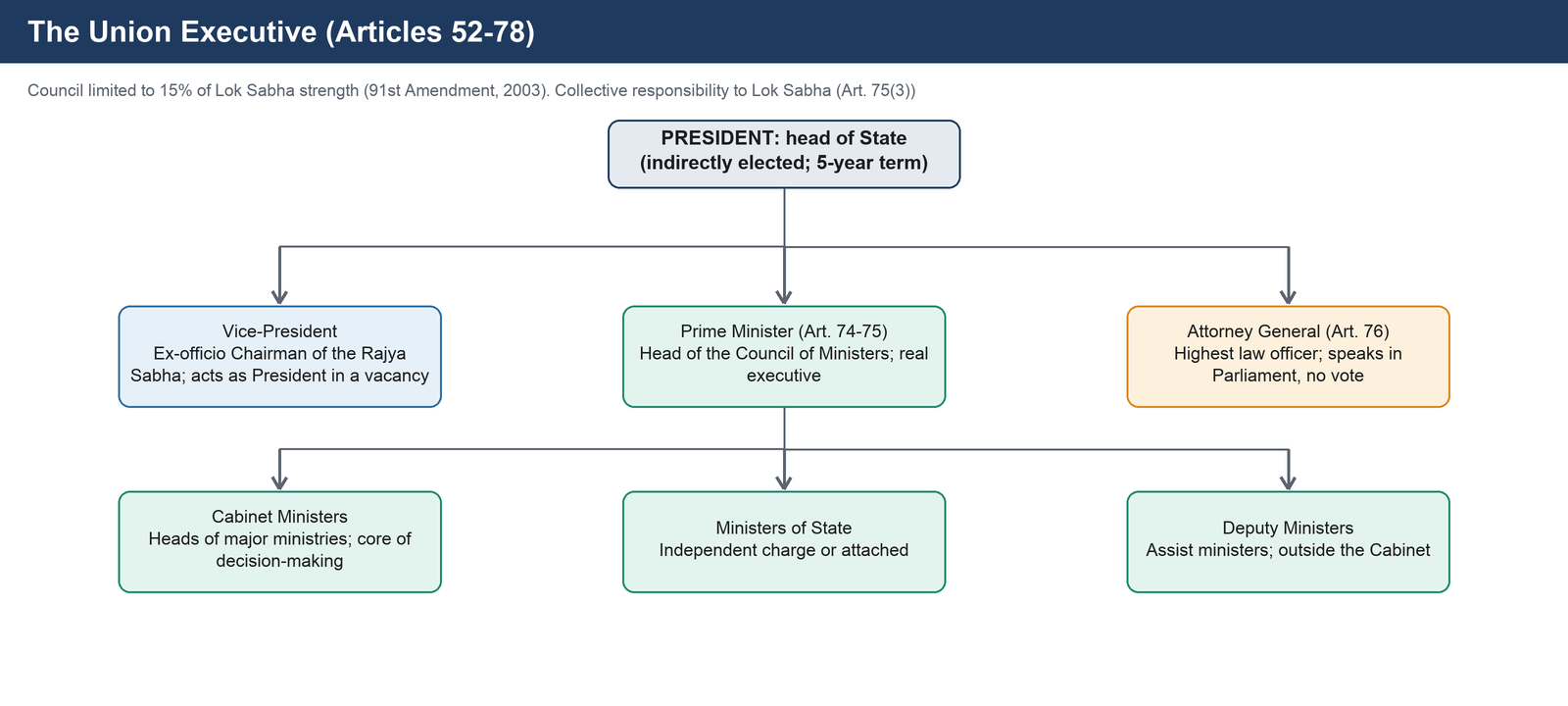
| Provision | Details |
|---|---|
| Appointment of ministers | President on the PM's advice |
| Size (91st Amendment, 2003) | At most 15% of the Lok Sabha strength; in a State at most 15% of the Assembly, minimum 12 |
| Non-member minister | Must become an MP within six months |
| Collective responsibility | Art. 75(3): to Lok Sabha |
| Individual responsibility | Art. 75(2): pleasure of the President |
| Cabinet committees | Extra-constitutional; set up by the PM |
| Attorney General | Art. 76; qualified as SC judge; speaks in Parliament but cannot vote |
The Council of Ministers is collectively responsible to
- The President
- The Lok Sabha
- The Rajya Sabha
- The Prime Minister alone
Practice questions are answered inside your account. Create a free account, or see what practice includes.
The total number of ministers in the Union Council of Ministers cannot exceed what percentage of the Lok Sabha?
- 10%
- 12%
- 15%
- 20%
Practice questions are answered inside your account. Create a free account, or see what practice includes.
Which of the following is NOT a constitutional office?
- Attorney General of India
- Solicitor General of India
- Comptroller and Auditor General
- Advocate General of a State
Practice questions are answered inside your account. Create a free account, or see what practice includes.
The Attorney General of India can
- Vote in Parliament
- Speak in Parliament but not vote
- Be a member of the Cabinet
- Not practise privately
Practice questions are answered inside your account. Create a free account, or see what practice includes.
Cabinet committees are established by
- The Constitution
- An Act of Parliament
- The Prime Minister (extra-constitutional)
- The President on his own
Practice questions are answered inside your account. Create a free account, or see what practice includes.
A person who is not a member of Parliament can be appointed a minister for a period of
- 3 months
- 6 months
- 1 year
- As long as the PM desires
Practice questions are answered inside your account. Create a free account, or see what practice includes.