Legislative Procedure: Ordinary Bills, Money Bills, Financial Bills and Joint Sittings
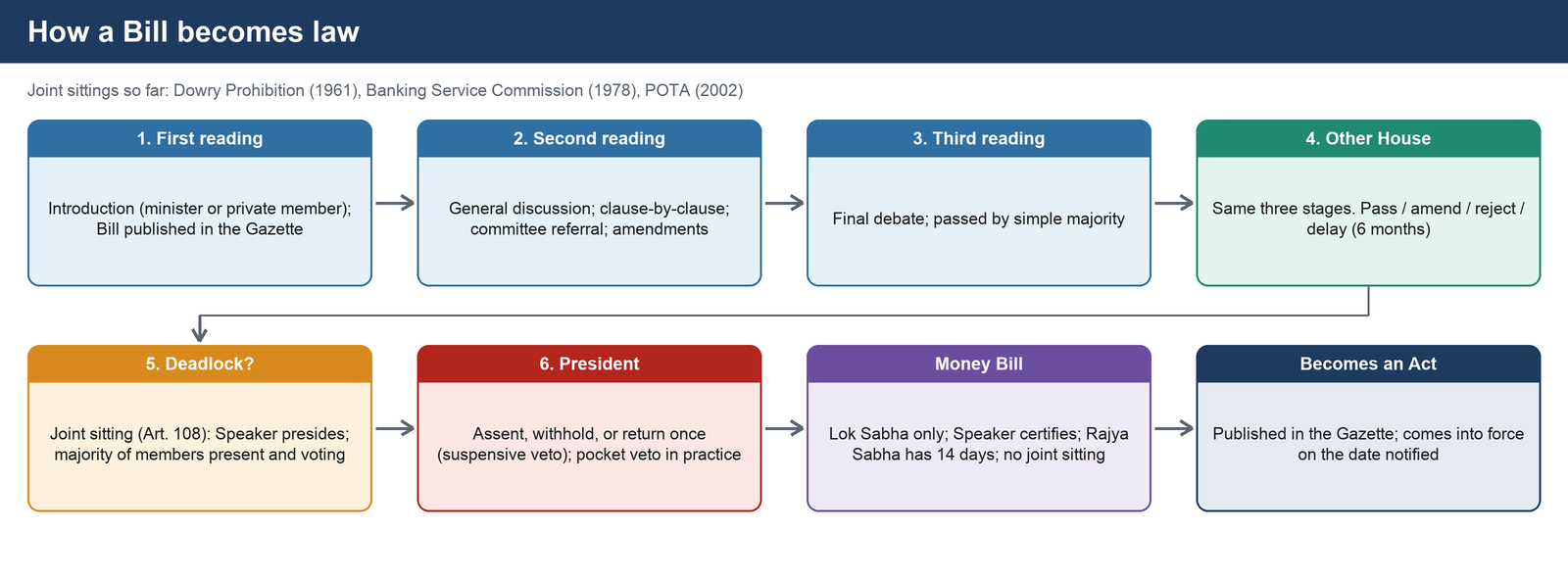
1. Introduction and first reading
| Feature | Ordinary Bill | Money Bill |
|---|---|---|
| Introduction | Either House | Lok Sabha only |
| President's recommendation | Not required (for introduction) | Required |
| Who can introduce | Minister or private member | Minister only |
| Rajya Sabha's power | Can pass, amend, reject or delay (up to 6 months) | Only recommend; return within 14 days |
| Joint sitting | Possible | Not applicable |
| Certification | None | Speaker certifies it a Money Bill |
| President's assent | Assent, withhold or return | Assent or withhold (cannot return) |
| Defeat in Lok Sabha | May not imply resignation (unless a government Bill is vital) | Resignation of government |
- Transmission to the second House
- Third reading and passage
- Second reading (general discussion and clause-by-clause)
- Presidential assent
- Introduction and first reading
Practice questions are answered inside your account. Create a free account, or see what practice includes.
A Money Bill can be introduced
- In either House
- Only in the Rajya Sabha
- Only in the Lok Sabha
- In a joint sitting
Practice questions are answered inside your account. Create a free account, or see what practice includes.
In case of a deadlock over an ordinary Bill, the joint sitting is presided over by
- The President
- The Chairman of the Rajya Sabha
- The Speaker
- The Prime Minister
Practice questions are answered inside your account. Create a free account, or see what practice includes.
Which of the following Bills was passed at a joint sitting of Parliament?
- Right to Information Bill
- Prevention of Terrorism Bill, 2002
- Goods and Services Tax Bill
- Aadhaar Bill
Practice questions are answered inside your account. Create a free account, or see what practice includes.
An ordinance issued by the President ceases to operate unless approved by Parliament within
- Six weeks from its reassembly
- Six months of promulgation
- One year
- Thirty days of promulgation
Practice questions are answered inside your account. Create a free account, or see what practice includes.
The President's veto over an ordinary Bill is
- Absolute
- Suspensive
- Pocket veto only
- Non-existent
Practice questions are answered inside your account. Create a free account, or see what practice includes.
A Bill pending in the Rajya Sabha but not yet passed by the Lok Sabha
- Lapses on dissolution of the Lok Sabha
- Does not lapse
- Is deemed passed
- Goes to joint sitting
Practice questions are answered inside your account. Create a free account, or see what practice includes.